Season Two
August 8 - September 21, 2025
Hollande Bezan
Return to the farm
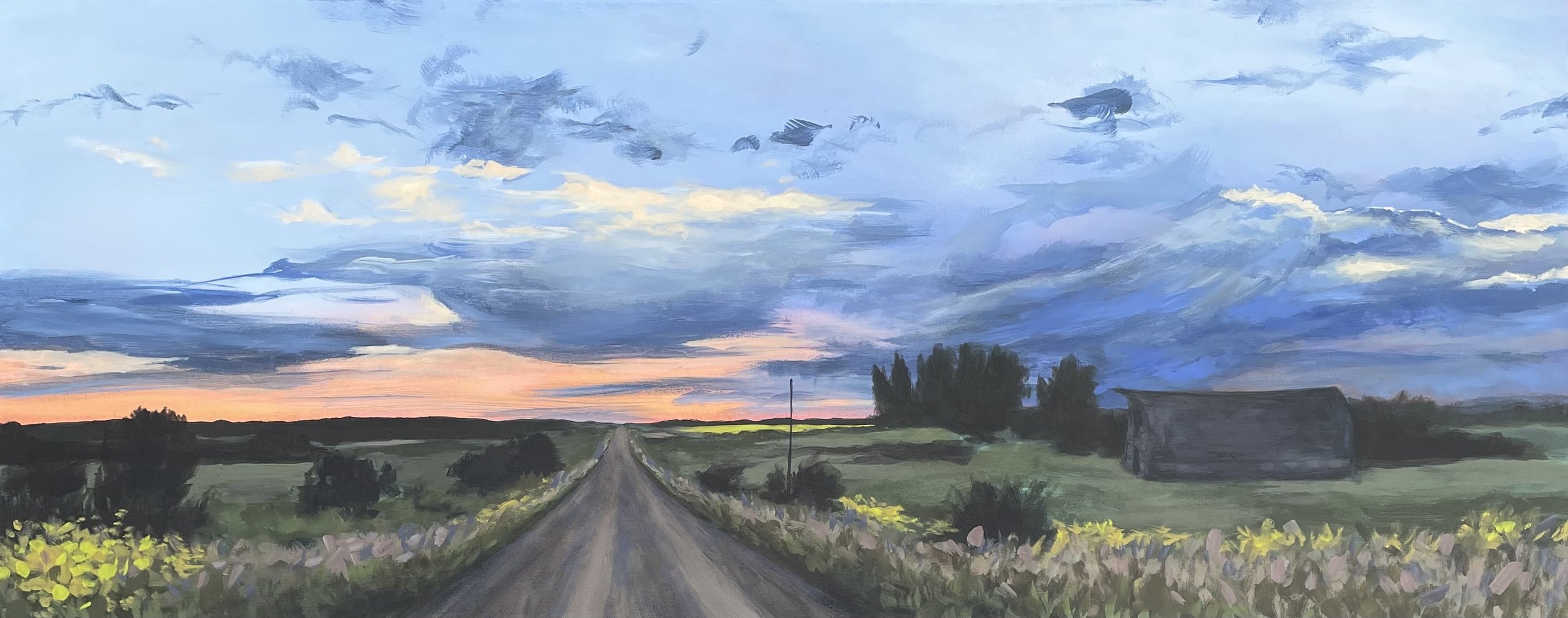
Hollande Bezan pays tribute to her family’s agricultural roots with a thoughtful series of 40 paintings in Return to the farm. Anchored in the rural landscape just north of Inglis, Manitoba, this body of work explores over a century of connection to the land, honouring the Bezan family and its enduring legacy through five generations.
Bezan draws from her memory and return visits to the farm. Her view hovers at the threshold of its domestic and outdoor spaces, exploring the passage of time, its cyclical nature, and rituals. She depicts the quiet transformation of place via weathered barns, pastures, and intimate corners of her grandparents’ and great-grandparents’ adjoining farms. These works serve not only as an homage but also as a meditation on continuity, impermanence, and how the farm’s significance is cultivated across time.
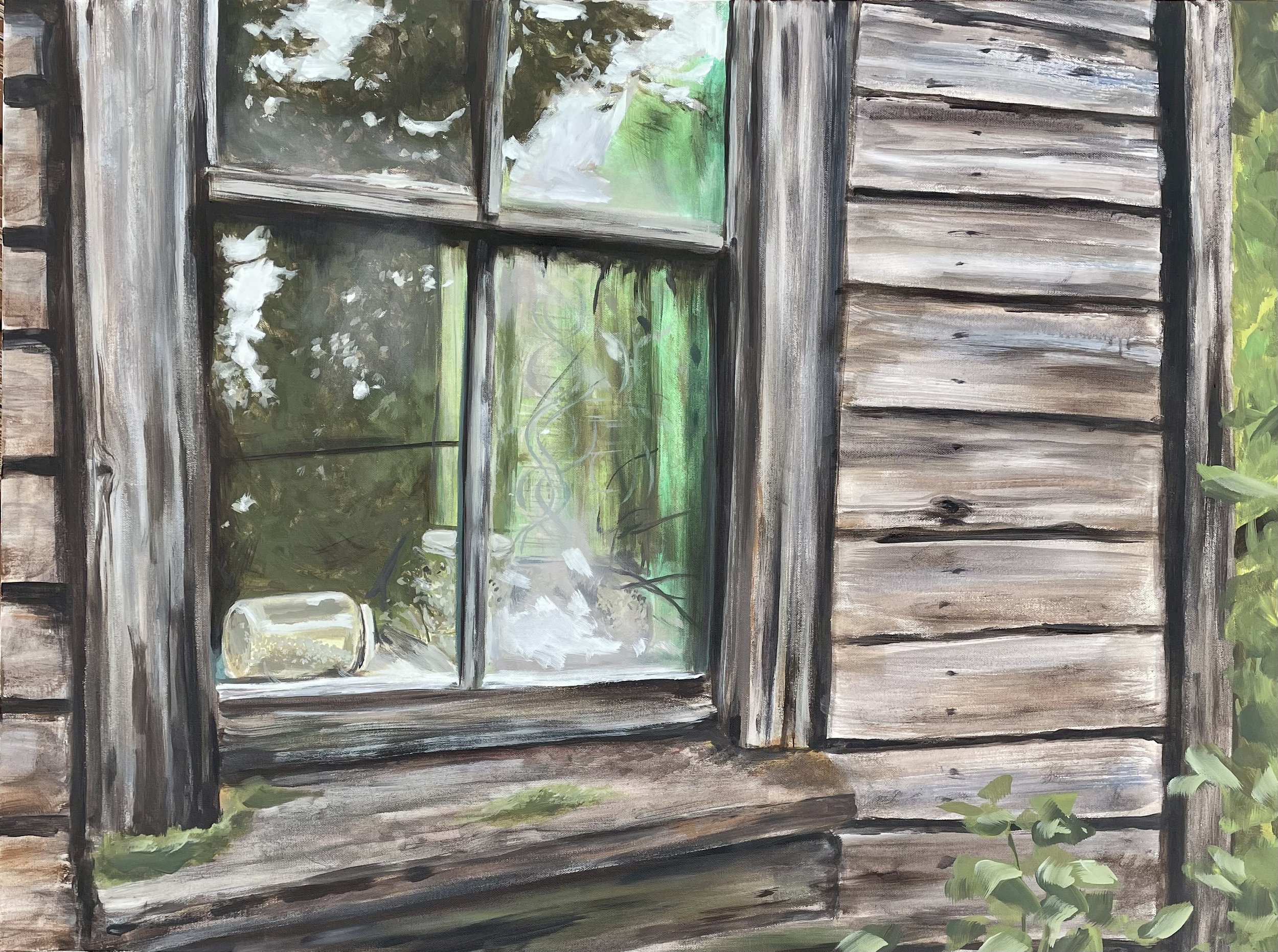
Hollande Bezan, Seeds of Succession. Acrylic on canvas. 30 x 40”. 2025.
Hollande Bezan
Hollande Bezan is a visual artist based in Winnipeg, Manitoba. Her drawings and paintings are inspired by enigmatic everyday objects and scenes that collectively capture lived experiences. Through emotions ranging from humour to nostalgia, her works tell stories of the textures, ties, and affective patterns that give meaning to modern day life.
Bezan earned her BFA with Honours at University of Manitoba in 2015. Her work has been exhibited at Woodlands Gallery, MAWA (Mentoring Artists for Women’s Art), The Edge Urban Art Gallery, and La maison des artistes Visuels.
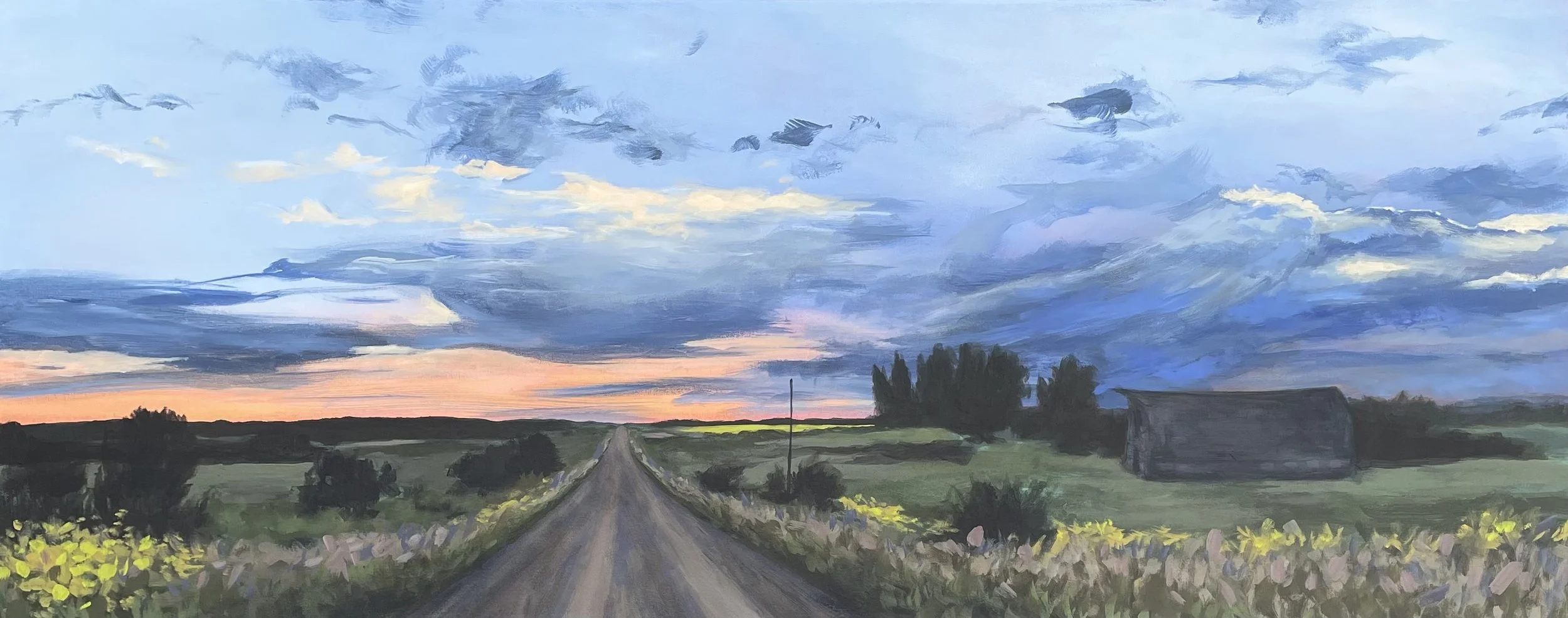
Hollande Bezan, Learning to breathe. Acrylic on canvas. 24 x 60”. 2025.
Kae Sasaki
In her work, Kae Sasaki strives to reinvigorate the narrative and atmospheric possibilities of painting, pushing its capacity to create worlds that are at once familiar and extraordinary. Her paintings reflect a continued exploration of the tension between spatial reality and the symbolic, between the seen and the felt. Drawing on everyday corporeal and architectural experiences, she constructs images that bridge, the material and the imagined, situating the viewer in spaces that oscillate between memory, perception, and dream.
The paintings begin with an intentional focus on composition and colour, a deliberate structuring of space and palette that lays the groundwork for deeper discovery. As the process unfolds, she reworks and revises each surface until the image transcends its initial form, revealing unforeseen meanings and psychological undercurrents. At this stage, symbols and other elements emerge intuitively, allowing the work to open itself in a multi-vocal way, inviting complex interpretations. The interplay between control and spontaneity produces a conceptual tension, a quiet yet persistent conflict, that brings the work into focus while maintaining an aura of mystery.
These layered visual worlds are not just explorations of architectural grandeur; they are intimate interrogations of the emotional and symbolic weight that such spaces carry. Opera houses, with their sweeping interiors, gilded ornamentation, and rich histories, become fertile ground for narratives of performance, collective experience, and cultural memory. Yet, as the psychological and symbolic components take over, the paintings transcend their subject, destabilizing easy readings and deepening engagement.
This body of work reflects Sasaki’s ongoing interest in how painting can mediate between perception, memory, and narrative within the shifting, often conflicting terrain of contemporary Canadian painting. The layered meanings within the paintings emanate from a profound emotional connection to life experience, creating a dialogue between presence and absence, grandeur and decay, silence and sound between what is readily grasped and what resists understanding.

Kae Sasaki, I Hear It Well But Scarcely Grasp It. Acrylic on canvas. 36 x 48”. 2017.
Wanda Slawik
A Year Without Christmas
This special collection of my mono-prints and paintings emerged in the pandemic years, between 2020 and 2022.
Slawik remembers those days of silence, social isolation and emotional pain we endured. We witnessed family breakdowns, career disintegration and personal challenges all around us. Our hope was shaken. Constant restrictions marred our daily struggles and each day the news made our outlook more uncertain and bleak. The world changed beyond recognition - the seasons of celebration were gone; our Christmas did not return.
We did not know how long this would last… And in this uncertain time, Slawik’s one reaction was to create. It was her cure and her way to reach to the core of her being, the place that was essential and most vital to her existence.
It was then that she recalled the Winnipeg New Music Festival of 2003 and the day when she first heard a brilliant piece by Georgian composer Giya Kancheli, titled, “Life without Christmas”. The work spoke of deep sorrow and perhaps the hope for better days in some tragic place of Kancheli’s experience. Little did she know that this deeply moving music would someday, represent her own reality…and even inspire her own hope for the future. Slawik’s paintings document those feelings and experiences.

Wanda Slawik, How Can I Live My Life Up to 25% Capacity? Mixed media. 22 x 28”. 2021.
Season One
June 5 - July 31, 2025
Miriam Rudolph
Layered Histories: Perspectives on Colonization from the Chaco
This exhibition is an artist's book that explores the complexities of colonization of the Paraguayan Chaco region through layered etchings and diverging narratives of experiences and history from the perspectives of the Enxet and Enlhet Indigenous people, Anglican missionaries and Mennonite settlers. This collection of prints and texts has emerged from an invitation for an artist residency from the SDCELAR (Santo Domingo Centre for Excellence in Latin American Research) at the British Museum.
“I was invited to engage with and create an artistic response to the Paraguay collection that is housed in storage at the British Museum in London. The collection consists of Indigenous artefacts collected by Anglican missionaries in the early 1900s. This project gave me the opportunity to research the early colonization history of the Lower Chaco from the Anglican perspective, and to further explore the colonial history of my own roots – the settlement of Mennonites in the Central Chaco beginning in 1927, which resulted in the displacement of the Enlhet Norte.”
The prints and text excerpts trace the events of early contacts between European missionary explorers, settlers and Indigenous people through the changes in landscape and ways of living to today's attempts at Indigenous assertion of their rights and tentative perspectives for the future. We often think of colonization as a process of history in the past. However, the impacts of colonization continue to pervade everything in our lives today: social structures and systems, our perception of land and property, the way we think about, interact with, and treat others on whose land we now live, whose artefacts we store, and whose experiences are not taught in schools. This artist's book invites to question our biases, our perceptions, and our understanding of history, and challenges us to decolonize our thinking.
To purchase a published version of this book in English and Spanish, click here: https://www.etsy.com/ca/listing/1441570080/layered-histories-perspectives-on?ref=shop_home_active_1&logging_key=a3f3cc33a88d686d1f42a532f4af653a8f9d0590%3A1441570080
To access and read a digital version of this book in English, click here: https://drive.google.com/file/d/1B9Nu5xd5xpn8aN5nBsj1enqY0oBAr_yJ/view
You can view Miriam Rudolph’s artist talk from March 2022, here: https://www.youtube.com/watch?v=YjyHQH7Mtm8&t=335s
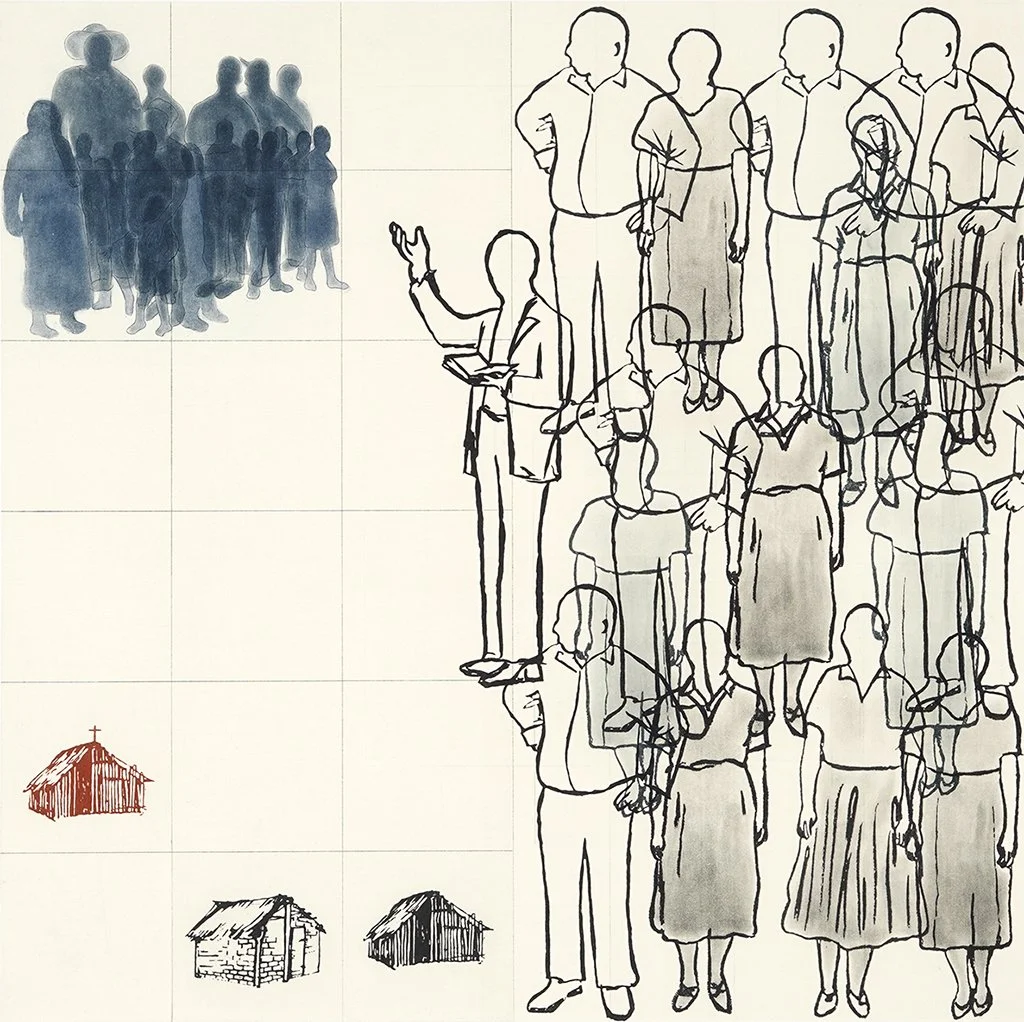
Miriam Rudolph, Encounters. Intaglio, Chine-Collé. 45 x 45cm. 2022.
Storied Land: (Re)Mapping Winnipeg
This exhibition exists as an artist book in addition to a series of prints, exploring segments of the colonial and racial history of settlement in Manitoba and Winnipeg through the use of layered etchings that recall the diverging narratives of experiences. These histories have been sourced from local newspaper archives and from various accounts of Indigenous people, Métis people, and Mennonite settlers. This collection of prints and texts emerged from an invitation from the Winnipeg Art Gallery to create a series of prints for the exhibition Headlines: The Art of the News Cycle in celebration of the 150th anniversary of the Winnipeg Free Press.
”This project gave me the opportunity to learn more about the colonial history of Winnipeg. It also allowed me to further explore the colonial history of my own roots and challenge the settler narratives I grew up with. My maternal great great great grandparents were among the early Mennonite settlers that migrated to Manitoba between 1874-1877.”
To access and read a digital version of this book, click here: https://drive.google.com/file/d/1vEWF5_CF1EKVnoO3N2UAKTmoz9l3rwp_/view?pli=1
To view Miriam Rudolph’s artist talk from January 13, 2023 at the Winnipeg Art Gallery - Qaumajuk, click here: https://www.youtube.com/watch?v=SPIKV0VfGU8
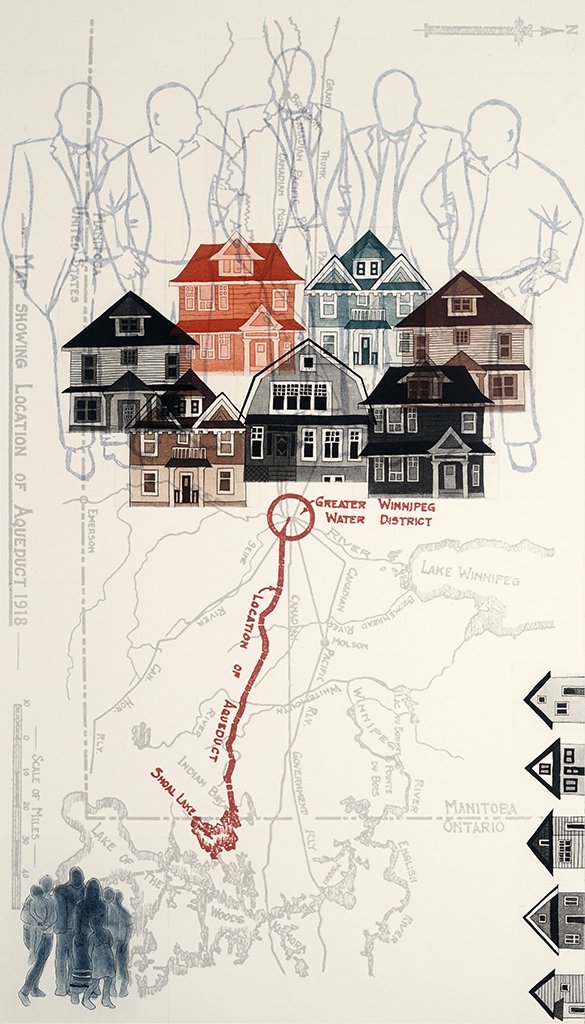
Miriam Rudolph, The Aqueduct. Intaglio, Digital Print. 30.5 x 53 cm. 2022.
Aileen Friesen & Anikó Szabó
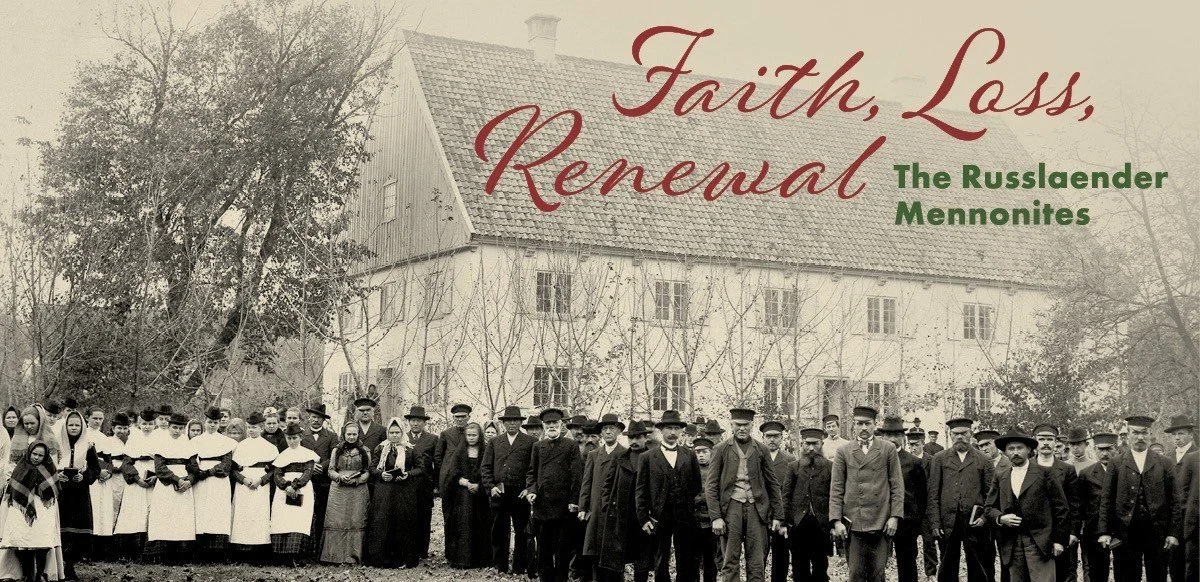
Faith, Loss, Renewal: The Russlaender Mennonites
This exhibition depicts the physical and emotional journey of 21,000 Mennonites from the Soviet Union to Canada during the 1920s.
Using historical photographs and texts from those who decided to leave, this exhibit follows their experience of revolution, civil war, and immigration. It explores the heaviness of faith during periods of violence, and uncertainty.